Ventilation outlets allow air from indoor spaces and building systems to be discharged outside through the roof or façade. They are used for natural and mechanical ventilation, bathroom and kitchen extraction, sewer stack ventilation, utility rooms, and other systems.
The quality of a ventilation outlet installation affects more than just the performance of the ventilation system. An improperly installed roof penetration can cause leaks, condensation, unpleasant odours, moisture penetration beneath the roofing, and damage to thermal insulation or waterproofing.
In Spain, it is particularly important to take into account the type of roof, intense solar heating, strong winds, heavy rainfall, and the building’s operating conditions. In coastal areas, high humidity and exposure to salty air are additional factors, so exterior components should be made from materials suitable for these conditions.
For both accessible and non-accessible flat roofs, the connection between the outlet and the waterproofing must be properly executed. On pitched roofs, the type of tiles or other roofing material, the roof slope, and the direction of rainwater runoff must be considered.
If the work is carried out in an apartment building and affects the shared roof, façade, ventilation shaft, or other common elements of the building, approval from the comunidad de propietarios may be required before installation begins.
Our service can help you find a verified professional near you who can assess the existing ventilation system, select the appropriate type of outlet, and carry out the installation with consideration for the building structure and operating conditions in Spain.
Installation of a ventilation outlet through a pitched roof
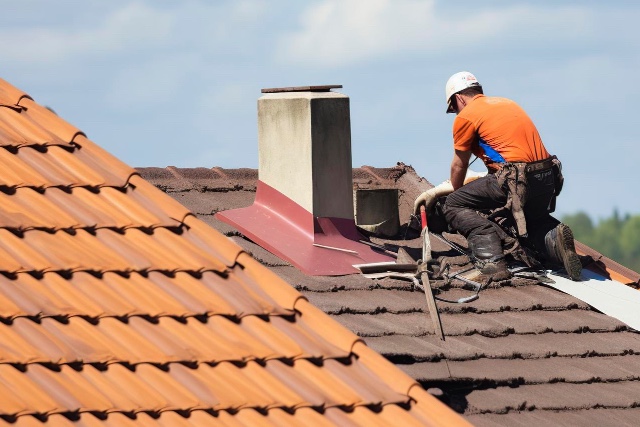
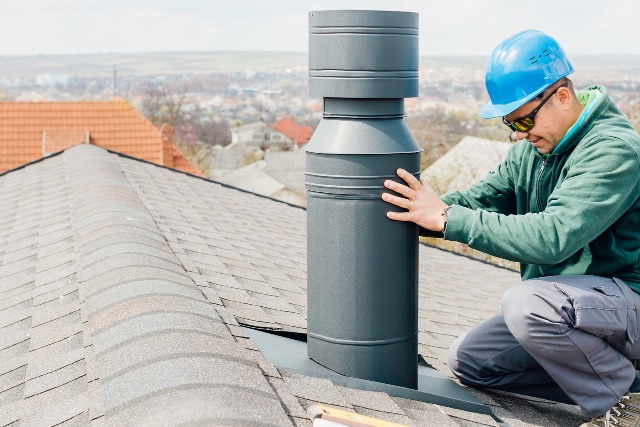
On pitched roofs, ventilation outlets are installed according to the type of roofing material, such as ceramic or concrete tiles, metal panels, bituminous materials, or other roofing systems.
The main task is not simply to route the ventilation duct outside. The penetration must be properly integrated into the roof structure and the area around it must remain watertight.
Particular attention is paid to the junctions around the penetration. Rainwater flowing down the roof slope must not be able to enter beneath the roofing at the point where the outlet is installed.
The height and position of the external section are selected according to the roof structure, surrounding elements, and the requirements of the specific ventilation system.
What should be discussed in advance:
type of roofing material;
roof slope;
ventilation duct diameter;
location of the roof penetration;
compatibility of the penetration element with the roofing;
sealing method;
condition of the waterproofing;
whether the duct requires thermal insulation;
position in relation to other roof elements;
possibility of safe access for installation.
Installation of ventilation outlets on a flat roof
Flat roofs are widespread in Spain, including on apartment buildings, modern villas, commercial buildings, and properties with technical areas on the roof.
When installing a ventilation outlet, it is particularly important to make the penetration through the waterproofing layer correctly. Even a small defect in the junction can eventually allow water to enter the roof structure.
If the roof is accessible or used as a terrace, the location of terraces, walkways, equipment, and recreational areas must also be considered.
The external component must be resistant to sunlight, wind, and precipitation. On exposed roofs in Spain, this is especially important because surfaces can become extremely hot during summer.
What to pay attention to:
flat roof construction;
existing waterproofing;
location of thermal insulation;
duct diameter;
height of the ventilation outlet;
method used to form the junction;
direction of rainwater drainage;
location of roof drains;
access for future maintenance;
compatibility of materials.
Bathroom and wc ventilation outlet installation
Bathroom ventilation helps remove humid air after a shower or bath. Insufficient air exchange can contribute to condensation, mould growth, and damage to finishing materials.
Depending on the building, air may be discharged through an existing ventilation shaft or through a separate duct leading outside.
If a mechanical extractor fan is installed, it is important to consider not only its capacity but also the duct diameter, route length, number of bends, and overall system resistance.
With long ducts or complex layouts, an incorrectly selected fan may operate noisily while still providing insufficient airflow.
What should be agreed in advance:
existing ventilation layout;
possibility of connecting to the ventilation shaft;
need for a separate outlet;
duct diameter;
fan capacity;
length of the ventilation duct;
number of bends;
need for a backdraft damper;
protection against condensation;
equipment noise level.
Installation of a kitchen extractor hood outlet
A kitchen extractor hood removes air containing steam, odours, and grease particles. For efficient operation, it is important to organise not only the connection of the hood itself but also the entire duct route up to the point where the air is discharged.
A duct that is too narrow, a large number of sharp bends, or an excessively long route can significantly reduce actual system performance and increase noise.
Special attention should be paid to where the air is discharged. Whether a kitchen extractor hood can be connected to an existing shaft depends on the design and intended purpose of that shaft.
In an apartment building, it should not automatically be assumed that any ventilation shaft is suitable for connecting a powerful kitchen extractor hood.
What should be considered:
extractor hood model and capacity;
recommended duct diameter;
duct route length;
number of bends;
existing ventilation system;
location of the external outlet;
backdraft damper;
sound insulation, if necessary;
access to connections;
rules of the comunidad de propietarios if common elements of the building are affected.
Installation of a sewer stack vent outlet
Ventilation of the drainage system helps stabilise pressure inside the pipework and ensures the proper operation of traps and plumbing fixtures.
If the ventilation is not working correctly, characteristic noises may occur in the pipes, water seals in traps may be disrupted, and unpleasant odours may enter the building.
The sewer stack outlet should be positioned correctly and protected against foreign objects entering it, while its design must not restrict normal airflow.
It is particularly important not to confuse sewer ventilation with ordinary room exhaust ventilation, as these systems perform different functions.
What should be agreed:
location of the existing stack;
pipe diameter;
possibility of extending the stack to the roof;
location of the penetration;
height of the external section;
waterproofing and sealing of the roof penetration;
position relative to windows and terraces;
condition of the existing drainage system;
need for additional work inside the building.
Replacement and repair of existing ventilation outlets
An old ventilation outlet does not always need to be completely replaced. Sometimes the problem is caused by a damaged cap, cracked seal, defective junction, or worn roof penetration element.
The cause of the problem should first be identified. If moisture appears near the outlet during rainfall, the source of the leak may not be directly around the pipe but further up the roof slope.
On older roofs, the condition of the surrounding roofing and waterproofing should also be checked. Simply replacing the sealant may not solve the problem if deeper layers of the roofing system are damaged.
What to pay attention to:
condition of the outlet itself;
watertightness of the junction;
condition of the penetration element;
roofing around the outlet;
waterproofing;
signs of condensation;
condition of the air duct;
fixing of the external section;
possibility of a local repair;
whether complete replacement is more appropriate.
Turnkey ventilation outlet installation
A comprehensive service may include inspection of the existing system, selection of the outlet location, preparation of the opening, installation or connection of the air duct, creation of the roof penetration, installation of the external element, sealing, and testing of the ventilation system.
If the work is carried out at the same time as roof repair or replacement, it is advisable to determine the position of ventilation outlets in advance. This makes it possible to integrate the penetration elements correctly with the waterproofing and roofing.
For properties within comunidades de propietarios and urbanizaciones in Spain, it is also advisable to check roof access conditions, rules for carrying out work in common areas, and whether approval is required for modifications affecting common elements of the building.
What should be clear before work begins:
purpose of the ventilation outlet;
installation location;
type and diameter of the air duct;
roof construction;
method used to create the penetration;
whether sealing is included;
whether the roofing needs to be restored;
who supplies the materials;
whether removal of the old outlet is included;
whether access through common areas is required;
who is responsible for construction waste;
completion time;
cost of additional roofing work;
acceptance and payment procedure.
How to choose a professional for ventilation outlet installation
At first glance, the task may seem simple: route a pipe through the roof and install a protective element on top. In practice, two systems meet at this point — ventilation and roofing — so a mistake can result either in poor ventilation performance or in roof leaks.
Experience specifically with roof penetrations. It is useful to look at examples of similar work. Installing an outlet through a tiled pitched roof, a waterproofed flat roof, and a metal roof requires different solutions.
Understanding of ventilation systems. The professional should determine what the duct is intended for: bathroom ventilation, kitchen extraction, a utility room, a sewer stack, or another system. Simply installing an outlet of the correct diameter is not enough — it is important to understand how it interacts with the rest of the system.
Roof inspection before installation. Before making an opening, the roof structure and the position of the waterproofing, insulation, rafters, and other elements should be determined. This is particularly important in existing buildings, where the actual construction may not fully correspond to the original documentation.
Correct selection of the penetration element. The penetration should match both the type of roofing and the duct diameter. A universal solution is not suitable for every roof. For tiled roofs, it is particularly important to use an element that allows rainwater to drain correctly around the penetration.
Attention to waterproofing. Watertightness should not rely solely on a thick layer of external sealant. A reliable solution must take into account the construction of the roofing system itself and the direction in which water flows. On flat roofs, it is particularly important to integrate the penetration correctly with the existing waterproofing.
Consideration of the Spanish climate. External roof elements in Spain can become extremely hot in direct sunlight. Materials should be suitable for exposure to UV radiation, temperature changes, and precipitation. In coastal areas, the corrosion resistance of metal components and fasteners is also important.
Inspection of the existing ventilation system. If the problem is poor airflow or unpleasant odours, installing a new cap will not always solve it. The cause may be inside the duct itself, in the fan, an incorrect duct diameter, too many bends, or insufficient supply air.
Safe work on the roof. Access to a ventilation outlet often involves working at height. The contractor should assess safe access and the need for appropriate protective equipment before starting work. This is especially important on steep pitched roofs and buildings without convenient roof access.
Working with the comunidad de propietarios. If the roof or façade is part of the common elements of an apartment building, the possibility of creating a new opening or modifying an existing outlet should be checked before work begins. There may also be internal rules governing roof access and construction work.
Clear quotation. The quotation should ideally show exactly what is included in the price: removal of the old element, the new ventilation outlet, ductwork, penetration element, fixings, waterproofing work, restoration of the roofing, and waste disposal. This makes it easier to compare professionals based on the actual scope of work rather than only on the final price.
Warranty for installation and watertightness. After the work is completed, it is useful to understand what warranty is provided for the installation and the completed roof junction. For a new roof penetration, it is especially important to establish in advance who is responsible for any leaks that may occur in the area where the work was carried out.
Frequently asked questions (FAQ)
▸ How is a ventilation outlet usually installed?
First, the professional determines the purpose of the duct and inspects the proposed outlet location. The roof structure is then checked, a suitable penetration element is selected, and the position of the opening is determined.
After the penetration has been prepared, the air duct and external element are installed, and the waterproofing and roofing around the opening are restored. Finally, the fixing, watertightness, and operation of the ventilation system are checked.
▸ Can a ventilation outlet be installed on an existing finished roof?
Yes. This type of work is regularly carried out on existing roofs.
The main issue is to dismantle the necessary section of the roofing correctly and restore it after installation. On tiled roofs, some tiles are usually removed, while on flat roofs particular attention is paid to restoring the waterproofing.
▸ Where is the best place to position a ventilation outlet?
The location depends on the purpose of the duct and the design of the building and roof. The route is generally kept as direct as possible, avoiding unnecessary long horizontal sections and excessive bends.
Rafters, rooftop equipment, windows, terraces, solar panels, and other elements should also be taken into account.
▸ Can ventilation be routed through a tiled roof?
Yes. Penetration elements compatible with the specific type of roofing are used for this purpose.
It is important that water can flow freely around the penetration and continue down the roof slope without entering beneath the tiles.
▸ Can an outlet be installed on a flat roof?
Yes. This is a common solution for flat roofs, but correct integration with the waterproofing is particularly important.
Before installation, the type of existing roofing system should be identified, as different waterproofing materials require different installation methods.
▸ Why can a roof leak after a ventilation outlet has been installed?
A common cause is an incorrectly formed junction between the penetration element and the roofing or waterproofing.
However, the source of the water is not always directly next to the pipe. On a pitched roof, water may enter further up the slope and travel beneath the roofing, so the actual point of water ingress should be identified before repairs are carried out.
▸ Is it enough simply to apply sealant around the pipe?
For a temporary local repair, this may sometimes be sufficient, but it should not be considered the main method for creating a new roof penetration.
Reliability depends on the correct design of the penetration element, proper junctions, and restoration of the waterproofing. Sealant is generally only one part of the system.
▸ Does a ventilation duct need thermal insulation?
It depends on the location and purpose of the duct. If warm, humid air passes through a cold area, condensation can form inside the duct.
For this reason, the route should be designed with consideration not only for its diameter but also for the conditions in attics, technical spaces, and exterior sections.
▸ Why does water appear inside a ventilation duct?
It may be condensation or rainwater entering through an incorrectly installed external element.
If the problem occurs regularly, the source of the moisture should first be identified. Simply replacing the cap may not be enough.
▸ Can a kitchen extractor hood be vented through the roof?
Technically, yes, and this solution is often used in private houses.
However, the extractor capacity, duct diameter, duct length, number of bends, and design of the external outlet should all be considered. A duct that is too narrow or complicated can significantly reduce extraction performance.
▸ Can a kitchen extractor hood be connected to an existing ventilation shaft?
Not every extractor hood can be connected to every shaft. The purpose of the existing duct and the building’s ventilation layout should first be established.
This should be checked particularly carefully in apartment buildings, where an incorrect connection may affect the operation of the shared ventilation system.
▸ Is a backdraft damper necessary?
In many mechanical ventilation systems, it is used to limit reverse airflow, but whether one is required depends on the specific system design.
When selecting a damper, it is worth considering not only its presence but also its resistance, noise, and accessibility for maintenance.
▸ Why does the ventilation still work poorly after a new outlet has been installed?
The cause may not be the external outlet. System performance is affected by the diameter and length of the duct, bends, dirt or obstructions, the fan, resistance from grilles, and the availability of supply air.
For this reason, when ventilation performance is poor, it is advisable to assess the entire system rather than only the roof outlet.
▸ Can several ventilation ducts be combined into one outlet?
Some systems are designed to combine ducts, but they should not be connected together arbitrarily.
A kitchen extractor hood, bathroom ventilation, sewer stack ventilation, and other systems serve different purposes. Whether they can be combined should be determined by the ventilation design of the specific building.
▸ Does sewer ventilation need a separate outlet?
In many systems, the sewer stack includes ventilation that helps stabilise pressure and protect the water seals in plumbing traps.
If unpleasant odours or characteristic gurgling sounds regularly occur in the home, the condition of the sewer ventilation may be one of the things that should be checked.
▸ Can a ventilation outlet be installed near solar panels?
Yes, provided that the selected position does not interfere with the normal operation or maintenance of either system.
Before making the opening, it is useful to consider not only the existing panels but also any plans for future expansion. On many homes in Spain, roof space is actively used for solar installations.
▸ How important is the height of the ventilation outlet above the roof?
The required height depends on the type of system, roof design, surrounding elements, and the applicable technical solution.
An outlet that is too low can cause problems under certain conditions, but making the pipe unnecessarily high is also undesirable because it increases wind loads and fixing requirements.
▸ What should be considered when installing an outlet near the sea?
In coastal areas of Spain, metal components and fasteners may be more exposed to corrosion due to humidity and salty air.
It is therefore advisable to discuss the materials used for the external element and its fixings in advance, particularly if the outlet is located on a fully exposed roof.
▸ Is approval from the comunidad de propietarios required?
Work carried out entirely inside an apartment without affecting common elements is different from creating a new opening in a shared roof or façade.
Roofs, façades, and shared ventilation shafts in apartment buildings are often common elements. Before altering them, it is therefore advisable to check the rules of the specific comunidad de propietarios and whether the relevant approval is required.
▸ Can only the external cap be replaced?
Yes. If the penetration, duct, and waterproofing are in good condition, replacing only the damaged external component may sometimes be sufficient.
However, if there are already signs of water around the outlet, the entire junction should first be inspected. A new cap will not repair damaged waterproofing.
▸ How can the quality of the installation be checked after the work is completed?
The stability and fixing of the outlet, the condition of the surrounding roofing, the quality of the junctions, and any obvious potential points of water ingress are usually checked.
The ventilation itself should also be tested. A neatly installed roof element does not necessarily mean that air is flowing properly through the duct.
▸ Can a ventilation outlet be installed during summer in Spain?
Yes, but the intense heating of roof surfaces and materials must be taken into account when working on the roof. On hot days, the temperature of the roofing can be significantly higher than the air temperature.
In addition to working conditions for the installers, the requirements of waterproofing and sealing materials should also be considered. Some products have limitations regarding application temperatures.
▸ Can installation be carried out while it is raining?
Opening up the roof structure during heavy rain is generally undesirable. Even if the installation itself takes little time, the exposed section must be protected from water ingress.
For planned work, it is therefore advisable to consider the weather forecast in advance.
▸ What determines the cost of installing a ventilation outlet?
The price depends on the type of roof, the height and accessibility of the work area, duct diameter, route length, type of penetration element, whether an existing outlet must be removed, and the amount of roofing work required.
Additional costs may arise if waterproofing needs to be restored, a large section of tiles has to be removed, a new air duct must be installed, the work area is difficult to access, or special safe roof access needs to be arranged.
Before installation begins, it is advisable to obtain a clear quotation and check whether it includes materials, the penetration element, external outlet, fixings, sealing, restoration of the roofing, removal of old elements, and disposal of construction waste.
Platform capabilities
Expert
I can provide repair and construction services in Spain
 Request your free quote